
WVPU Appoints Judith Albrecht to Lead Ethnography Institute
July 15, 2026
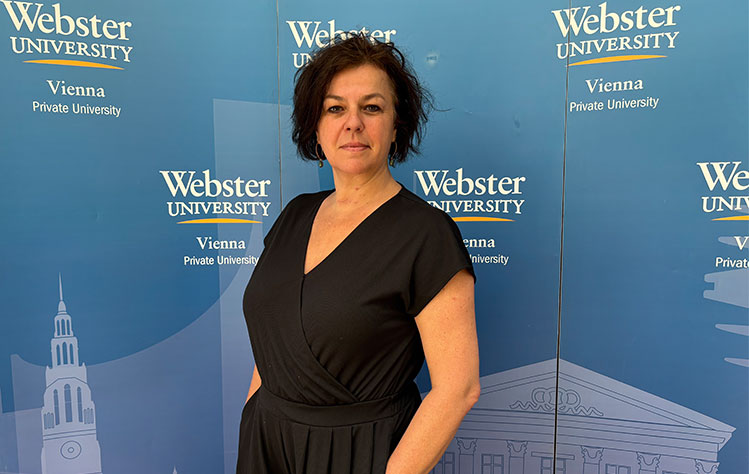 Judith Albrecht
Webster Vienna Private University (WVPU) has appointed Judith Albrecht, PhD, as director of its new Research Institute for Interdisciplinary Ethnography on Violence, Gender, Sexuality and Justice.
An internationally recognized social anthropologist and visual ethnographer, Albrecht brings more than 25 years of research and community-engaged experience on gender, violence, trauma, displacement and justice across Africa, Europe and the United States.
A German national, Albrecht earned her PhD in Social Anthropology from Freie Universität Berlin. Her work as a social and public anthropologist and visual ethnographer at Freie Universität Berlin, Humboldt University Berlin and the University of Graz has focused on gender, violence and the embodied consequences of trauma.
Drawing on long-term research in Tanzania, Malawi, Iran, Libya, Germany and the United States, and through extensive collaboration with refugees and diaspora communities, Albrecht combines regional expertise with participatory, community-based research. Her additional training as a trauma social worker provides the methodological and ethical grounding for working with survivors of violence, while her expertise in visual and multimodal ethnography expands anthropology’s methodological repertoire through film, photography and digital media.
Albrecht’s research strengthens WVPU’s Society and Individuals Under Change cluster through its focus on gender, violence, trauma, identity and displacement. Her expertise in social anthropology, public anthropology, visual ethnography and multimodal methods enhances the university’s qualitative and participatory research profile while contributing to research on changing social practices, belonging and migration.
Through the new Research Institute for Interdisciplinary Ethnography, Albrecht will further expand WVPU’s research visibility and societal impact by generating empirically grounded contributions to contemporary debates on justice, inclusion and social change.
The institute seeks to reintroduce gender as a critical analytical category of difference at a time when public and political debates increasingly treat gender primarily as an identity category. It investigates how violence, gender, sexuality and justice are experienced, negotiated and contested in everyday life while examining the structural conditions and power relations that shape these experiences.
At the heart of the institute is ethnography. Understanding lived, embodied and felt experiences of difference requires long-term engagement with the worlds people inhabit. Through sustained fieldwork, documentation and collaboration with communities, the institute explores the intersections of violence, gender inequality and justice across diverse social contexts.
The institute understands ethnography not simply as a method of observation but as a critical engagement with the social, political and historical structures shaping people's lives. By connecting individual and collective experiences to broader systems of power, governance, law and inequality, ethnographic research reveals how structural violence and social exclusion are reproduced while also illuminating practices of resistance, care and social transformation.
By combining ethnographic inquiry with interdisciplinary perspectives, the institute generates grounded knowledge that links personal experiences with wider social, political and historical processes. Guided by the conviction that understanding begins with being there, the institute contributes to both academic scholarship and public debate on violence, gender, sexuality and justice.