
Francisco Gómez Jiménez Explores How Culture Shapes Sexuality and Gender
September 29, 2026
Francisco Gómez Jiménez recently joined Webster Vienna Private University as assistant professor of psychology.
His academic training spans biology, psychology, and evolutionary behavioral science. He received his B.Sc. in Biology from the University of Puerto Rico, Mayagüez, before completing an M.Sc. in Psychology and a Ph.D. in evolution and behaviour at the University of Lethbridge in Canada.
Gómez Jiménez's graduate research focused on the cross-cultural variability and evolutionary origins of sexual and gender diversity. He subsequently joined the University of Toronto as a postdoctoral fellow, where his research examined childhood gender development and the emergence of gendered behavior. He later moved to the UK, joining Brunel University London as a lecturer in psychology. His current research integrates his cross-disciplinary background by exploring sexual diversity through developmental, biopsychological, evolutionary, and cross-cultural perspectives, from its origins and correlates to variation in mate preferences and the effects of stigma and minority stress.
WVPU recently asked him more about his research and expertise in the interview below.
My area of expertise is human sexuality and gender, particularly understanding where our sexuality and gender come from, how they develop, and how they vary across cultures. At the heart of my research is a fairly simple question: how do our biological and developmental histories interact with the cultural and social environments in which we grow up to shape the ways we experience and express sexuality and gender?
I’m particularly interested in questions that challenge the assumption that what we observe in one cultural context necessarily reflects universal aspects of human development. Much of the research on sexuality and gender has been conducted in Western, predominantly Euro-American contexts. By working across different cultures, I’m interested in understanding which aspects may reflect more general developmental or evolutionary processes, and which are shaped by the particular environments in which people grow up. This has led me to work with sexually- and gender-diverse populations in places such as Mexico and Thailand, as well as to study how children themselves come to understand gender.
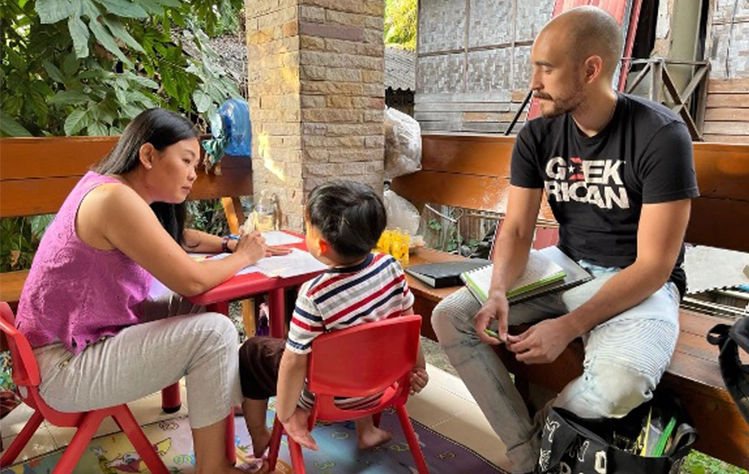
Dr. Francisco Gómez Jiménez (right) with Thai Research Assistant Aunyawee Chaiwatpornpat,
interviewing a child participant in Chiang Mai, Thailand, in November 2023 as part
of an ongoing developmental study examining how children understand and express gender
across different cultural contexts.
One of my current research programs looks at how cultural acceptance and visibility of gender diversity influence children’s understanding of gender and the psychological wellbeing of transgender and gender-diverse children. As part of this project, my collaborators and I have been comparing children growing up in different cultural contexts, including Canada, Thailand, Hong Kong, and Mexico and we’re excited to start sharing some of our results.
I’m also interested in exploring whether the elevated mental health challenges we often see among sexual and gender minorities in Western societies are universal. This developing line of research asks, for example, whether sexual and gender minorities in the Istmo Zapotec communities of Oaxaca, Mexico, or in Northern Thailand, where gender and sexual diversity can be more culturally visible and socially recognized, experience the same challenges. If not, what is different about the cultural environments in which they live, and what can we learn from them? Understanding these differences may help us better understand the factors that shape mental health and wellbeing among sexual and gender minorities.
Ultimately, I want to contribute to a more genuinely international understanding of human sexuality and gender. This means recognizing both the developmental and evolutionary foundations of human behavior and the enormous influence of culture. In the longer term, I hope to help establish WVPU at the forefront of the scientific study of sexual and gender diversity, building a research program that is internationally recognized for bringing together rigorous psychological science with evolutionary, developmental, and cross-cultural perspectives.
Contributing to this goal, I recently organized and participated in a research symposium where I represented WVPU as part of the Society for Research in Child Development’s (SRCD) Special Topics Meeting on Sexual Orientation and Gender Identity in Childhood and Adolescence. The symposium brought together research from Thailand and China examining how children understand and express gender across different cultural contexts.
The symposium presented our ongoing research in Thailand, where we are exploring how cisgender and gender-diverse children develop and express their understanding of gender in a cultural context where gender diversity is relatively visible and socially recognised. Across the studies, we examined children’s own gender identities, how they understand and conceptualize other people’s gender, and how gender expression is reflected in children’s speech. Together, the three studies revealed culturally specific patterns in gender-diverse children’s gender identities, a developmental shift towards more flexible ways of categorising gender, and evidence that children’s vocal expression aligns with their gender expression rather than their sex assigned at birth. These findings challenge the notion that gender development can be understood independently of culture, and raise an important question: how much of what we know about gender development is universal, and how much is shaped by the cultural environments in which children grow up?
The symposium was part of a much broader meeting that brought together not only developmental scientists, but also people working across policy, education, health, advocacy, and other areas concerned with the lives of sexual and gender minority children and adolescents. This made the meeting a valuable opportunity to think about how research can move beyond the academic setting and inform wider conversations surrounding children’s development and wellbeing.