
WVPU Research in Porto: Financing Early-Stage Ventures
September 15, 2026

Members of the 2026 conference board
Over the summer, Professor Kevin Reuther represented Webster Vienna Private University
at two international academic events in Porto, Portugal.
Reuther is Associate Professor of Entrepreneurship and Innovation at WVPU, the new Head of the Business and Management Department, and directs the SEAM Research Institute.
Reuther attended the 2026 IEEE International Conference on Engineering, Technology, and Innovation (ICE/ITMC) and the NITIM Graduate School at the Alfândega do Porto. ICE is one of the flagship conferences of the IEEE Technology and Engineering Management Society.
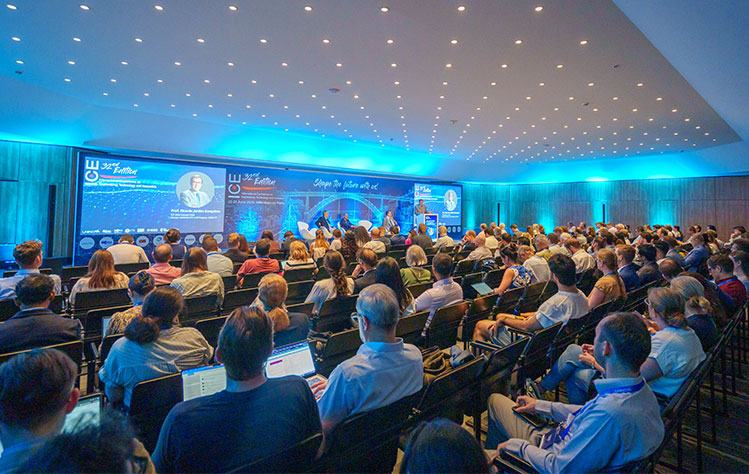
Attendees of the conference opening session
Reuther served as Head of the Conference Review Board alongside co-chair Dr.-Ing. Abdulrahman Abdelrazek of Fraunhofer IAO and contributed as Topic Chair for Entrepreneurship. ICE follows a rigorous peer review process, with each paper receiving two to three independent reviews and topic chairs acting as desk reviewers and editors. This process underpins the quality of the conference proceedings, which are published in IEEE Xplore and are typically released towards the end of the year.
While at the conference, which took place in June, Reuther also chaired the entrepreneurship sessions together with Professor Yngve Dahle of the Hauge School of Management in Bergen and Professor Christina Ungerer of HTWG Konstanz. Among the research presented were his two co-authored papers that approach early-stage venture financing from opposite ends of the funding chain. One research paper looks at what happens after public money reaches a young venture. The other paper asks how private investors decide which ventures should receive capital in the first place. Read together, they raise a broader question about what funding can, and cannot, achieve on its own.
The first study, written with Niklas Schmid and Guido Baltes of HTWG Konstanz, Carolin Schmidt and Philipp Steininger of Leipzig University, and Yngve Dahle of the Hauge School of Management, examines when small public grants actually help young companies survive. Using data from the SEAM Research Institute, the team analyzed 158 ventures in a north-western Norwegian entrepreneurial ecosystem three years after they received support, comparing ventures in rural and urban settings.
Two findings stand out. First, venture failure rarely comes down to a single missing resource. It is more likely when several constraints accumulate, for example when a thin funding base coincides with a small team and limited access to useful networks. Second, microfunding, understood here as small non-repayable grants rather than credit, does not sustain a venture by itself. Its value becomes most visible where the surrounding ecosystem is weak, particularly in rural regions, and even there it depends on whether the venture has the internal capacity to make productive use of the money. For programme designers, this changes the question from simply how much money to provide to what needs to accompany it. A modest grant combined with mentoring and access to relevant networks may achieve more than the same budget distributed as an isolated financial transfer.
The second study, written with Tanja Pietsch and Christina Ungerer of HTWG Konstanz, looks at the other end of the financing chain. It compares how traditional venture capital and impact venture capital investors assess sustainable start-ups. Combining a systematic review of 29 articles with expert interviews among investors and founders in the DACH region, the study finds that the two types of investors are less different in their basic evaluation logic than one might expect.
Financial performance remains the primary criterion for both. Sustainability changes how opportunities pass through that logic rather than replacing it. Traditional investors may use sustainability concerns as a reason to exclude an opportunity, while impact investors use sustainability performance as an additional reason to include one. In both cases, however, sustainability is layered onto the financial assessment rather than substituted for it.
The result is a more selective version of a familiar investment logic. That also points to a limit: ventures whose social or environmental impact is substantial but difficult to monetise may still struggle to fit the expectations of market-based capital, even when investors explicitly pursue impact.
Taken together, the two studies arrive at a similar conclusion from very different starting points. The effects of finance depend heavily on what surrounds it. For a small public grant, mentoring, networks and the venture's own capabilities shape whether the money can make a difference. For private investment, the criteria and assumptions surrounding the capital determine which kinds of ventures are considered investable in the first place. The design around a funding instrument may therefore matter at least as much as the size of the instrument itself.
The NITIM Graduate School takes place each year alongside the ICE conference, bringing both communities together in the same host city. NITIM focuses on Networks, Innovation, Technology and Information Management and gives doctoral candidates the opportunity to discuss their research proposals in depth with faculty from partner institutions across Europe and beyond. Entrepreneurship and innovation is one of its three priority areas. In Porto, Reuther reviewed and discussed doctoral projects at different stages of development. For WVPU, participation in NITIM also provides a connection to an established European research network that complements the doctoral programmes of its member institutions.