
WVPU’s Inaugural Leadership Talk Explores How Countries Can Win with AI
November 10, 2026
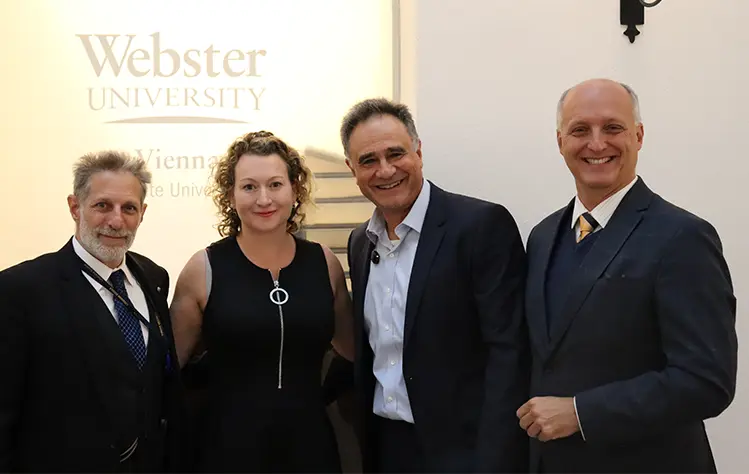
Samuel R. Schubert, Allison Snowden, Karim Taga and Stefano Cantini at the event.
Artificial intelligence has an image problem of an unusual kind: it looks as if it
weighs nothing. Answers arrive from “the cloud,” and clouds are light. However Hyperion,
a data center being built by Meta in Louisiana, is not.
The center spans 2,250 acres, will draw at least 2.6 gigawatts of power and has raised about $30 billion, the biggest financing amount for a single data center on record. (Arthur D. Little, a consultancy, advised on the deal.)
Karim Taga, PhD, a managing partner and a WVPU Alumnus, used the data center as opening example at the inaugural Leadership Talks, a new series launched by WVPU and supported by the American Chamber of Commerce in Austria.
The series, hosted by the WVPU Alumni Network, brings together experts and leaders to examine the forces reshaping how organizations compete and lead in a rapidly changing global environment.
For the first edition, Taga, who also heads global functional practices at Arthur D. Little, presented “AI’s Hidden Dependencies: The Strategic Race Reshaping Business, Energy and Global Power.”
Taga examined the physical infrastructure behind artificial intelligence, which he describes as a dependency tower. At the top sits intelligence, the models themselves. Each layer beneath rests on the next: Models need computing power, computing needs chips, chips need data centers, and data centers need electricity, grid connections, water and land. As demand grows, the bottleneck slides down the tower, away from the cleverness of models and toward the plumbing beneath them. And the plumbing is scarce.
Scarcity breeds dependency, Taga argued, and dependency breeds leverage. Whoever controls a hard-to-replace layer of the tower can set terms for everyone above it, which is how a question of engineering becomes one of geopolitics.
Rather than asking who builds the smartest model, Taga asked what it means for a country to win the AI economy. He keeps two scorecards. The first records the value a country realizes at home, through more productive firms, more capable workers and stronger institutions. The second records what it captures from global demand: exports, intellectual property, infrastructure and work done for foreign customers. Doing well on one guarantees nothing on the other. You do not need to own the best model to win at home, he said, but you do need to capture value somewhere.
No country needs to lead every layer of AI, and no choice is free. Building sovereign models and infrastructure is expensive; buying the best technology on offer leaves the rents and the control abroad. Full sovereignty, in Taga's reckoning, is a luxury: It raises costs and slows the spread of the technology. The trick is to be selective. Realize value at home, capture it abroad and secure only the dependencies whose loss would threaten economic continuity.
Would your AI keep running if one foreign supplier cut access tomorrow? If not, he warned, your AI economy is on loan. The greatest risk, he concluded, is not choosing the wrong path, it is drifting into one by default.
Welcome remarks were delivered by Stefano Cantini, WVPU alumnus and president of the Alumni Association Vienna chapter. The event concluded with a reception, giving attendees an opportunity to continue the conversation and connect with fellow guests.